
Heavy Equipment Installation Precision Problems? Tangshan Yuexin Machinery Ships Custom Non-Standard Base, Solving Large Foundation Part Challenges with 22 Years of Experience
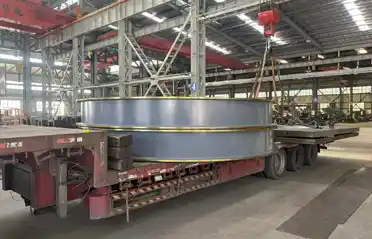
Recently, in the production workshop of Tangshan Yuexin Machinery Manufacturing Co., Ltd., a large ring-shaped structural component several meters in diameter was steadily hoisted onto a flatbed trailer with the assistance of a 10-ton overhead crane, marking the completion and shipment of another batch of custom non-standard base parts for a metallurgical industry customer. The component is welded from Q355B steel plate, stress-relieved by annealing, and then CNC-machined as a whole, with end-face runout controlled within 0.15mm, fully meeting the high-precision requirements of on-site equipment installation.
Why Do Customers Prefer Custom Solutions Over Standard Parts? — Real-World Demand Behind Non-Standard Bases
In heavy industries such as metallurgy, mining, thermal power, and chemical processing, equipment foundation parts are never a matter of "buy a standard part and install it." The mounting hole patterns, load distributions, and on-site foundation conditions of main equipment from different manufacturers vary widely. Standard bases often suffer from mismatched hole positions, insufficient rigidity, or excessive vibration after installation — minor issues cause rework and schedule delays, while major ones affect the stable operation of entire production lines.
According to the technical director of Yuexin Machinery, this batch of parts was shipped to a customer from a steel enterprise in North China, used as the foundation support structure for a newly installed ball mill transmission system. The customer initially considered purchasing standard-size bases, but after on-site measurement, found that due to constraints from the existing floor height and spacing between adjacent equipment, the standard component dimensions exceeded the installation space by 300mm, and the flange hole pattern could not match the main reducer base. "When the customer came to us with drawings, they cared about three things: whether dimensions could be precisely achieved, whether welding deformation could be controlled, and whether delivery could meet their installation schedule," said the director.
It is precisely this "each piece of equipment is different" working condition that determines the rigid demand for custom foundation solutions in heavy industry — it is not optional, but the first line of defense for ensuring equipment installation accuracy and operational stability.
From Drawing to Finished Product — How Yuexin Machinery Controls Machining Precision for Large Custom Bases
The machining challenge for large ring or box-type base components lies in simultaneously achieving "large size" and "high precision." The larger the diameter, the higher the difficulty of controlling welding deformation, thermal deformation, and clamping deformation. If end-face flatness, bore cylindricity, or mounting hole positional tolerance is exceeded, on-site assembly becomes impossible.
Tangshan Yuexin Machinery has accumulated 22 years of machining experience in this field. The workshop is equipped with a large CNC gantry milling machine (12.5m length × 8.4m width × 4m height), heavy-duty horizontal lathes with 80-ton load capacity, and floor boring-milling machines, capable of handling overall machining of large structural components from 1 meter to over 10 meters in diameter. For this non-standard base project, the technical team adopted three key process measures:
First, leave machining allowance before welding and perform overall stress relief annealing after welding. All steel plates are first cut with at least 5mm machining allowance per side. After welding, the components go into an annealing furnace for overall stress relief to avoid deformation caused by residual stress release during subsequent machining.
Second, secondary clamping and split precision milling. Rough machining is followed by a 48-hour resting period to release machining stress, then semi-finish milling and finish milling are performed. The final end-face flatness is controlled within 0.1mm/m, with parallelism error not exceeding 0.15mm.
Third, CMM inspection of critical dimensions. All mounting hole positions and mating end faces are re-inspected with a coordinate measuring machine before delivery. Inspection reports accompany the shipment, allowing customers to verify directly against drawings on site.
"Many peers machine large parts right after welding and deliver right after rough machining. We insist on adding a resting step and a re-inspection step because we know how costly rework is when customers find parts don't fit on site," said the quality control supervisor of Yuexin Machinery.
Smooth Delivery — What Customers Value Beyond Precision
From the time the customer provided drawings to finished product shipment, the production cycle for this batch of custom parts was 28 days, 5 days ahead of the customer's expectation. Before loading, the customer sent technical personnel to the factory for pre-acceptance, verifying dimensions and surface treatment against drawings item by item, and signed off before arranging shipment.
For Yuexin Machinery, delivering large custom structural components is never just about "finishing the machining." From proactively optimizing welding structures during drawing review to reduce machining difficulty, to photographing and reporting progress at key machining milestones, to providing lifting point markings and rust-preventive packaging at shipment — these service details have become standard practice.
To date, Tangshan Yuexin Machinery's non-standard machining business covers metallurgical mill bases, mining crusher frames, thermal power fan foundation seats, chemical reaction tower support seats, and more. Customers span over a dozen provinces in China and export to Germany, Japan, Australia, Brazil, and other countries. The company maintains a "drawing-to-sample, all processes in-house" model — no outsourcing subcontracting. From cutting, welding, and heat treatment to machining and surface treatment, everything is completed in its own workshop. This is the core reason customers trust them with large critical foundation components.
For more information on large non-standard base customization cases and pricing, please contact Tangshan Yuexin Machinery Manufacturing Co., Ltd. at any time. We will provide a one-stop solution from process review to finished product delivery based on your drawings and working conditions.
Related News
- Can Tangshan Yuexin Solve Your Mechanical Parts Customization Needs?
- How to Choose a Manufacturer for Custom Non-Standard Parts? Insights from Tangshan Yuexin Machinery (22 Years of Experience)
- When outsourcing the machining of large-scale lifting arms, how can enterprises select a reliable manufacturer? How does the Tangshan Yuexin Gantry Machining Center balance precision and delivery schedules through customized processes?
- Frequent Steel Breakouts in Continuous Casting Tundishes? Tangshan Yuexin Guides You to the Right Manufacturer to Cut Costs and Boost Efficiency
- Tangshan Yuexin Machinery Manufacturing Co., Ltd. Successfully Ships a Batch of Large-Scale Mechanical Structural Components
- Production lines urgently need replacement parts but can't find standard specifications? Is Tangshan Yuexin Machinery, a non-standard parts customization manufacturer, reliable?
Leave me a message