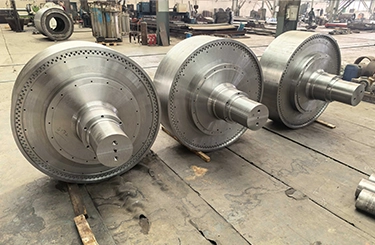

What is metallurgy, and what are metallurgical equipment?
The metallurgical industry is a pillar industry of the national economy, undertaking the crucial task of transforming mineral resources into metallic materials. Metallurgical equipment is the core carrier of this transformation process. From ore pretreatment to metal smelting, from refining and purification to rolling, each stage relies on the precise operation of specialized equipment. According to the metallurgical production process, metallurgical equipment can be divided into five major categories: raw material preparation equipment, smelting equipment, refining equipment, rolling mill equipment, and auxiliary equipment. Together, they form an efficient, high-quality, and low-consumption metallurgical production system.
I. Raw Material Preparation Equipment: The "Front-End Pretreatment Tool" of Metallurgical Production The first step in metallurgical production is the pretreatment of raw materials to remove impurities and adjust their composition, providing qualified raw materials for subsequent smelting. Raw material preparation equipment is fundamental to ensuring smelting efficiency and product quality. Core equipment includes:
**Crushing and Screening Equipment:** Jaw crushers, cone crushers, and impact crushers handle the crushing of large ore pieces, breaking the raw ore to particle sizes suitable for smelting. Vibrating screens and circular vibrating screens classify the crushed ore, screening out raw materials with uniform particle sizes and separating impurities.
**Mixing and Batching Equipment:** A mixing stacker-reclaimer achieves uniform mixing of ore components through layered stacking and end-face reclaiming, preventing component fluctuations from affecting smelting. Disc feeders and belt scales precisely control the conveying volume of various raw materials according to the smelting formula, ensuring accurate batching ratios.
**Drying and Preheating Equipment:** Rotary dryers use hot air to remove moisture from raw materials, preventing moisture from affecting temperature and chemical reactions during smelting. In the coking process, coke ovens preheat coal to prepare for subsequent coking. For iron ore powder, pelletizing shaft furnaces or chain grate rotary kilns process it into pellets, improving the permeability of the raw materials and smelting efficiency.
II. Smelting Equipment: The "Core Reactor" for Metal Formation Smelting equipment is crucial for extracting metallic elements from ores through high-temperature chemical reactions to form crude metals. Based on the type of metal being smelted, it is mainly divided into two categories: ironmaking equipment and steelmaking equipment.
Ironmaking Equipment: The core is the blast furnace. A blast furnace is a tall, vertical reactor. Iron ore, coke, and limestone are charged from the top, while hot air is blown in from the bottom. A reduction reaction occurs at high temperatures, reducing iron from the iron ore to produce molten iron (pig iron). Supporting equipment includes blast furnace hot blast stoves (providing high-temperature hot air to the blast furnace), blast furnace gas purification equipment (recovering and utilizing the gas produced in the blast furnace), and molten iron ladle cars (transferring molten iron to the steelmaking workshop).
Steelmaking Equipment: Primarily used to remove impurities such as carbon, silicon, and manganese from pig iron and adjust the alloy composition to obtain qualified molten steel. Common steelmaking equipment includes converters (oxygen top-blown converters, oxygen bottom-blown converters), which rapidly oxidize impurities by blowing oxygen into the furnace, resulting in short smelting cycles and high efficiency; electric arc furnaces (AC electric arc furnaces, DC electric arc furnaces), which use an electric arc generated by electrodes to heat the furnace charge, can use scrap steel as raw material, offer high flexibility, and are often used in the smelting of special steels; and open-hearth furnaces, which are traditional steelmaking equipment, although having long smelting cycles, are highly adaptable to raw materials and are gradually being replaced by converters and electric arc furnaces.
III. Refining Equipment: "Quality Optimization Tools" for Steel Purification
Crude steel still contains small amounts of impurities (such as sulfur, phosphorus, and gases), and its compositional precision is insufficient. Refining equipment, through further chemical reactions and process control, improves the purity and compositional uniformity of the molten steel, meeting the production requirements of high-quality steel.
Ladle refining equipment: The LF furnace (ladle refining furnace) uses electrode heating and argon blowing to adjust the temperature and composition of molten steel and remove sulfur from it; it is the most widely used refining equipment. The RH vacuum refining unit uses a vacuum chamber to lift the molten steel, removing hydrogen, nitrogen, and other gases in a vacuum environment, reducing bubbles and improving the steel's toughness. The VD furnace (vacuum degassing furnace) and VOD furnace (vacuum oxygen blowing decarburizing furnace) also achieve degassing and decarburization through vacuum technology and are commonly used to produce high-quality bearing steel and stainless steel.
Continuous casting equipment: The continuous casting machine is used to continuously cast refined molten steel into billets, replacing the traditional ingot casting process and significantly improving production efficiency. The continuous casting machine initially solidifies the molten steel into a shell in a crystallizer, then further cools it in a secondary cooling zone, and finally, a straightener pulls the billet out and cuts it into square billets, slabs, round billets, etc., of fixed lengths to provide raw materials for subsequent steel rolling. The core of continuous casting equipment is the crystallizer, whose cooling effect directly determines the surface quality and internal structure of the cast billet.
IV. Rolling Mill Equipment: The "Shaping Tool" for Steel Formation
Rolling mill equipment applies pressure to steel billets, causing plastic deformation and rolling them into steel products of different specifications and shapes (such as plates, profiles, pipes, and wires). It is the "final forming process" in metallurgical production.
Hot Rolling Equipment: Steel billets heated to high temperatures (usually above 1000℃) are rolled through a rolling mill. Utilizing the good plasticity and low deformation resistance of steel at high temperatures, significant deformation is achieved. The main equipment includes a heating furnace (to heat the billet to the rolling temperature), a roughing mill (to perform preliminary rolling of the billet, adjusting its thickness and shape), a finishing mill (to precisely control the thickness, width, and surface quality of the steel), and a coiler (to roll hot-rolled plates into coils for easy storage and transportation). Common hot-rolled products include hot-rolled steel plates, hot-rolled strips, and hot-rolled sections.
Cold rolling equipment: This equipment rolls hot-rolled steel at room temperature. Cold rolling further reduces steel thickness, improves surface finish and dimensional accuracy, and enhances the steel's mechanical properties (such as strength and hardness). Core equipment includes cold rolling mills (multi-roll cold rolling mills, reversible cold rolling mills), which achieve high-precision deformation through multiple sets of rolls; annealing furnaces (continuous annealing furnaces, bell-type annealing furnaces), used to eliminate internal stress generated during cold rolling and restore the steel's plasticity; leveling machines, which flatten cold-rolled steel sheets to improve surface quality and shape; and coating equipment (galvanizing units, color coating units), which coat the surface of cold-rolled steel sheets with zinc or colored coatings to improve corrosion resistance and aesthetics.
Profile and pipe rolling mills: These are specifically used to produce profiles (such as angle steel, channel steel, and I-beams) and pipes (seamless steel pipes, welded pipes). Section steel rolling mills roll steel billets into sections with specific cross-sectional shapes through multiple rolling passes; seamless steel pipe rolling mills (such as piercing mills, continuous rolling mills, and sizing mills) produce seamless steel pipes from steel billets through piercing, rolling, and sizing processes; welded pipe mills produce welded pipes by rolling steel plates into tubular shapes and then welding them.
V. Auxiliary Supporting Equipment: The "Support System" for Metallurgical Production The complex metallurgical production process requires a series of auxiliary supporting equipment to ensure the smooth operation of each stage, while also handling waste generated during production to achieve environmental protection and safe production.
Power and Energy Equipment: Substations and transformers provide a stable power supply to the entire metallurgical plant; air compressors provide compressed air for pneumatic equipment; oxygen generators provide high-purity oxygen for equipment such as converters and blast furnaces; waste heat boilers recover waste heat generated during the smelting process, producing steam for power generation or heating, achieving energy recycling.
Logistics and Transportation Equipment: Bridge cranes and gantry cranes are used for hoisting raw materials, molten steel, and billets within the workshop; belt conveyors and roller conveyors enable continuous transport of raw materials and semi-finished products; trains and trucks are responsible for transporting raw materials and finished products outside the plant area.
Environmental Protection and Safety Equipment: Dust collectors (electrostatic precipitators, bag filters) treat dust generated during smelting and steel rolling, reducing air pollution; wastewater treatment equipment (sedimentation tanks, filters, membrane separation equipment) purifies production wastewater, allowing it to be recycled or discharged after meeting standards; desulfurization and denitrification equipment removes sulfur dioxide and nitrogen oxides from flue gas; in addition, there are gas holders (for storing coal gas), fire-fighting equipment (fire hydrants, fire extinguishers), and safety monitoring systems (temperature, pressure, and gas concentration monitoring), ensuring production safety and environmental friendliness.
Conclusion: Metallurgical equipment runs through the entire process from raw materials to finished products, from pretreatment of raw materials to metal extraction in the smelting stage, to quality optimization in refining and shaping of rolled steel. Various types of equipment work together to jointly promote the development of the metallurgical industry. With the advancement of industrial technology, metallurgical equipment is being upgraded towards larger scale, intelligence, and greenness. Large blast furnaces and heavy plate rolling mills are increasing production scale; intelligent control systems are enabling precise monitoring and automatic adjustment of equipment operation; and waste heat recovery and ultra-low emission equipment are helping the metallurgical industry achieve its "dual carbon" goals, providing solid support for the production of high-quality metal materials and sustainable development.
Related News
- What Is an Electrically-Driven Steel Ladle Car and Why Is It Essential for Modern Steel Plants
- How Does an Electrically-Driven Steel Ladle Car Improve Safety and Efficiency in Molten Metal Transport
- How Does a Hydraulic-Driven Steel Ladle Car Transform Modern Steelmaking Logistics
- How Can a Centrifugal Bucket Elevator Significantly Boost Your Material Handling Efficiency
- What Safety Advantages Does Tension Monitoring Provide in Plate Conveyors?
- What Makes a Steel Moving Machine the Ideal Solution for Heavy Material Handling?
Leave me a message